
Anúncios
What if a single change to your product could make millions of users feel safer, seen, and more likely to stay?
This how‑to is a practical blueprint for Inclusive Dating App Design that helps product teams ship an experience where people are respected, safe, and accurately represented.
Anúncios
In 2025 the market favors niche platforms with stronger loyalty and diverse revenue streams like subscriptions, in‑app perks, and LGBTQ‑friendly partnerships. Real gaps remain: 51% of LGB adults use online services, 24% meet partners there, but 56% report harassment.
Anúncios
Readers will get core principles, concrete features, tech stack choices, community testing, and safety ops. We draw on real examples such as Feeld and on US market realities to show why representation, privacy, and moderation matter for retention and monetization.
This guide targets product managers, founders, engineers, and safety teams working on platform development. Expect a focused, human‑centered mission: build products where users feel seen, safe, and in control.
Why inclusivity is non‑negotiable in dating apps today
Niche platforms are winning because they tailor experiences to diverse identities and reduce friction for users. In 2025, loyalty comes from personalization, clear safety controls, and respectful language. Product teams that treat those elements as essentials see higher retention and stronger word‑of‑mouth.
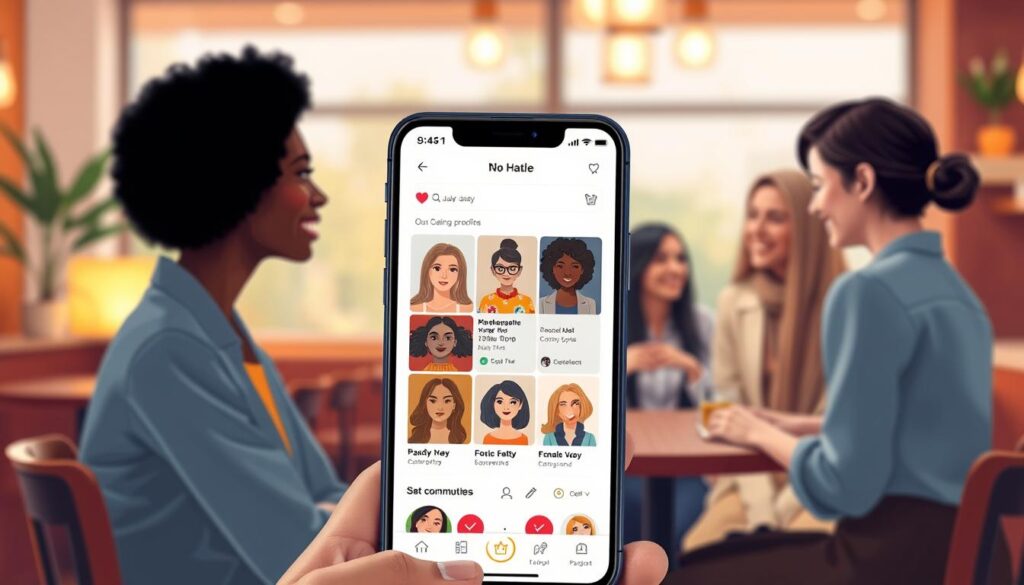
2025 market shifts: niche platforms, higher expectations, and loyalty
New platforms compete on more than matching logic; they offer granular identity fields, consent-first visibility, and community features that improve match quality. Mobile performance and WCAG compliance broaden reach and trust. When people can control location sharing and profile visibility, engagement rises and moderation escalations fall.
What mainstream apps miss for LGBTQ+ users (and why it matters)
Mainstream products often rely on generalized algorithms and limited gender or orientation options. That leads to poor recommendations and higher harassment rates.
51% of LGB adults used online services, 24% met partners there, and 56% reported harassment.
Closing these gaps is a business imperative. Thoughtful monetization that funds safety operations, clear privacy policies, and non‑exploitative paywalls keep users and protect reputation. Inclusive language and visuals by default prevent othering and help users feel respected.
- Better retention from tailored experiences.
- Lower moderation cost through proactive features.
- Stronger community engagement with events and groups.
User intent and who this How‑To guide is for
This guide helps product leaders, founders, designers, engineers, and safety ops who build or scale dating platforms in the United States. It focuses on practical steps teams can use to meet real user needs and improve retention.

Primary user intents covered here are safe discovery, meaningful matches, and a stronger sense of community for LGBTQ+ singles, couples, and polyamorous groups. Teams will learn how to translate those intents into measurable outcomes.
- PMs: prioritize inclusive roadmaps and KPIs.
- Designers: embed accessible patterns and clear microcopy.
- Engineers: implement privacy‑by‑default systems.
- Moderators: operationalize safety and verification flows.
Typical organizational needs include WCAG compliance, verification pipelines, and flexible identity models. The guide supports decision-making across discovery, development, launch, and iteration with checklists and feature trade-offs.
Use the guide to apply core principles, pick features that match your user research, validate with communities, and measure impact. These choices shape every part of the user experience—from onboarding through messaging and events.
This material applies to new builds and redesigns of existing apps. Align budgets, transparency, and community engagement, and set explicit goals for inclusivity, privacy, and retention that map to business KPIs.
Inclusive Dating App Design: core principles to anchor your product
Anchor your roadmap on a few nonnegotiable principles that protect people and improve outcomes. These principles act as guardrails during product development and help teams make consistent trade-offs.
Representation by default: language, microcopy, and visuals
Use gender-neutral language and broad identity options from the first screen. Show diverse photos and neutral microcopy that avoid making any user the default.
Consent, control, and visibility settings baked in
Offer granular controls for pronouns, photo visibility, and location. Include an anonymous browsing mode and clear toggles so users manage exposure without friction.
Safety-first interactions that reduce harm
Integrate reporting, blocking, and verification into onboarding and messaging flows. Make escalation paths obvious and fast to use.
Iterate with community input, not assumptions
“Regular feedback loops with advisory cohorts reduce costly rewrites and improve trust.”
| Principle | Concrete feature | Measured outcome |
|---|---|---|
| Representation by default | Wide identity fields, pronoun display | Higher profile completeness, better match relevance |
| Consent-first controls | Visibility toggles, incognito mode | Lower unwanted contact rates |
| Safety-led flows | Inline reporting and fast verification | Fewer escalations, faster response time |
Small rituals like monthly design crits with community advisors stop assumptions from guiding product choices. Tie each principle to metrics such as retention, safety escalations, and match satisfaction to prove impact.
Designing for gender, pronouns, and sexual orientations without friction
Small profile choices — like custom gender fields and visible pronouns — change how people connect. Make identity entry quick, optional, and easy to edit so users can reflect themselves over time.
Flexible identity options and editable visibility
Offer multiple selections and a free-text field so people list nuanced identities. Let users pick which options appear publicly, to matches, or only in certain spaces.
Support skipping sensitive questions during onboarding and make edits obvious in settings. This lowers friction and improves profile accuracy.
Pronouns across profiles, chat, and notifications
Show pronouns on the profile header, chat title, and push notifications to normalize use. Add short tooltips that explain terms without policing answers.
- Provide multiple gender and orientation selections with custom fields.
- Ensure editable visibility so users control what others see.
- Include localized lists but preserve user-defined entries.
- Flag misgendering in reports and route incidents to moderators quickly.
- Test these features with LGBTQ+ beta cohorts to reduce friction.
Design choices matter: avoid rigid defaults like binary match rules. Build flexible matching preferences and inclusive validation so no choice creates a dead end.
Trust, safety, and privacy by design
Users stay when they feel protected; safety and privacy must guide product decisions from day one.
Verification, AI/moderator workflows, and rapid response policies
Implement layered verification: photo and video liveness checks cut spoofing and bots. Pair AI triage with trained moderators for escalation and fast removals.
Anonymous browsing, location masking, and data minimization
Offer anonymous browsing and granular location masking. Never expose precise coordinates by default. Collect only required data, set retention limits, and provide clear deletion options.
Handling harassment at scale: report/block UX that users actually use
Embed single-tap report/block buttons across profiles and messages. Show progress updates, outcomes, and in-app safety tips. Publish SLAs and short policy summaries to build trust.
| Measure | What it does | Operational need |
|---|---|---|
| Layered verification | Reduces fraud and bots | Liveness tech + review team |
| AI + human moderation | Fast triage and fair escalation | Models, playbooks, 24/7 staffing |
| Data minimization & encryption | Limits exposure and risk | Retention policies, encrypted storage |
Treat safety as an ops discipline: budget moderation, train staff, and publish clear rapid-response commitments so users know the platform takes harm seriously.
Unbiased matching algorithms and fair moderation
A clear matching layer and fair rules make recommendations feel earned, not assumed. Teams should expose preference settings and explain how recommendations are shaped so users understand why matches appear.
Reducing bias with transparent preferences
Publish plain‑language notes that describe the role of weight, recency, and shared interests in algorithms. Let people adjust sliders or toggles to prioritize traits or loosen filters.
Audit models for disparate impact across gender and orientation. Run A/B tests and share summaries with community advisors to validate fairness.
Couple, group profiles and trans‑inclusive matching
Support couple and group profile types so polyamory and non‑monogamy are first‑class features. Show consent cues in matching flows and let users set visibility for group profiles.
Honor pronouns and gender fields in matching logic. Do not infer identities; allow users to state them and use those entries as primary signals.
- Explain preference effects and let users refine matches.
- Publish moderation standards and an appeal process.
- Log edge cases and review them with cross‑functional teams.
| Goal | Action | Outcome |
|---|---|---|
| Transparency | Preference explanations, audit logs | Higher trust, fewer bias reports |
| Polyamory support | Couple/group profiles, consent cues | Better match relevance for non‑monogamous users |
| Fair moderation | Published rules, appeal paths | Perceived fairness, faster resolution |
Accessibility that meets WCAG on mobile app experiences
Strong mobile accessibility turns small UI choices into major gains for users with diverse needs.
Commit to WCAG 2.1+ across the mobile app UI. Use strong color contrast, scalable text, and clear typography so content remains readable on different screens and lighting.
Provide full accessibility labels and a logical focus order for screen readers in onboarding, profiles, chat, and settings. Test with VoiceOver and TalkBack on iOS and Android to validate real-world behavior.
Include motion sensitivity controls to reduce animations and transitions that can trigger discomfort. Offer keyboard and switch-control alternatives for core flows and enlarge tap targets for reliable touch interaction.
“Accessibility is a continuous development priority: bake it into components, test often, and track regressions.”
- Caption videos, supply transcripts for audio, and enable live captions for events.
- Design forgiving forms with descriptive error states, inline guidance, and recovery options.
- Monitor accessibility regressions with automation and periodic human audits pre- and post-release.
Treat accessibility as ongoing work: make it part of the design system so new features ship with compliance in mind, and use data to measure improvements in reach and support load.
Community features that go beyond swipes
Community features turn casual browsing into real connection points where people meet, learn, and stay.
Offer event discovery for virtual meetups and safe IRL gatherings. Events help users connect around hobbies and local groups. Add RSVP flows, waitlists, and optional verification to keep turnout high and risks low.
Enable group chats and themed spaces so people find shared interests beyond one‑to‑one matches. Filters for interests and identities help surface relevant groups and reduce noise.
Well‑being resources and in‑app support
Curate helplines, mental health links, and quick safety tips directly in the app. Make support visible from profiles and group pages so users know where to turn after harassment or crisis.
Visible moderation and clear guidelines keep spaces respectful. Publish basic rules, show moderation status, and let users report content easily.
Platforms that mix social features with dating often see higher engagement and stronger retention.
| Feature | Benefit | Key metric |
|---|---|---|
| Event discovery & RSVP | Stronger local community ties | Repeat attendance rate |
| Group chats & interest spaces | Ongoing engagement beyond matches | Active group participation |
| In‑app support & helplines | Faster help for people in crisis | Resolution time and sentiment |
Partner with LGBTQ+‑friendly organizations to run events and provide vetted resources. Use user feedback from these features to refine matching and content relevance across the platform.
Learn more about our team and approach on the about page.
Monetization strategies that don’t compromise inclusivity
Monetization must reinforce healthy behavior and fair access for users. Revenue should fund safety ops and community features without gating basic protections.
Freemium model and subscription tiers users feel good about
Offer a freemium model that keeps core safety and discovery free. Paid tiers add value: advanced filters, read receipts, ad-free feeds, and priority placement.
Price tiers should not lock basic safety or search tools. Be clear about auto-renewal and include accessible discount options.
In‑app purchases: profile boosts, Super Likes, and virtual gifts
Let users buy one-time profile boosts, Super Likes, and themed virtual gifts. These features increase visibility without coercion when priced fairly.
Events, sponsorships, and LGBTQ‑friendly brand partnerships
Monetize events with ticketing and vetted sponsorships. Keep brand standards strict and share revenue with safety or well‑being programs.
Ads done right: relevance, controls, and transparency
Use non-intrusive ads with frequency caps and clear labeling. Give users control over ad relevance and an opt-out in paid tiers.
- Tie fees to community benefit: fund moderation and resources.
- Test willingness-to-pay and avoid aggressive paywalls.
- Keep premium communities and verification optional, not required.
Building the right team and operating model
Hiring people who know the communities you serve changes how quickly trust forms on a platform.
Start by defining core competencies for the team: inclusive UI/UX, safety operations, policy, moderation, data privacy, and reliability engineering.
Inclusive UI/UX, safety ops, and culturally competent moderation
Culturally trained moderators reduce harm and improve response quality for sensitive reports. Train moderators in bias awareness and trauma-informed support.
Invest in moderator tooling, case management, and ML-assisted triage so the team scales without losing context.
Why a specialized team outperforms generalist development
Specialized experience speeds product development for platforms that serve diverse users. Teams with prior work in community-led products ship better solutions and avoid common pitfalls.
- Structure 24/7 coverage with clear SLAs and escalation paths for high-risk incidents.
- Partner with LGBTQ+ advisors and organizations for periodic policy reviews.
- Align metrics to safety, trust, and user satisfaction—not just growth.
- Document runbooks for incidents, policy updates, and community communications.
Cross-functional ritualslike regular design critiques and safety reviews keep inclusion central to roadmap decisions.
Tech stack and architecture for scalable dating platforms
A pragmatic tech stack lets teams move from prototype to scale without rewriting core services.
Start with cross‑platform frameworks to speed development and reach mobile users fast. Choose React Native or Flutter for high velocity, and add native modules for camera, liveness checks, or heavy animation when needed.
Real‑time chat and cross‑platform choices
Use Firebase, WebSocket services, or managed messaging to provide delivery receipts, typing indicators, and media handling. Design message schemas to support end‑to‑end encryption and ephemeral media by default.
Backend, databases, and cloud for growth
Build APIs in Node.js or Python and protect them with rate limits and auth layers. Pick PostgreSQL for relational profile data and MongoDB for flexible, evolving profile fields.
- Architect for resilience with microservices, load balancing, caching, and auto‑scaling.
- Store images and videos on object storage with CDN delivery, signed URLs, privacy controls, and expiry policies.
- Secure data with encryption at rest/in transit, secrets management, and strong IAM in AWS, GCP, or Azure.
- Plan ML pipelines for matching and moderation with governance, monitoring, and rollback steps.
- Ship safely using feature flags, A/B testing, and a documented deployment runbook and DR plan.
Step your infrastructure toward observability — logs, metrics, and traces — so teams can iterate on algorithms and resolve incidents fast. This approach keeps the platform reliable, private, and ready for growth.
From MVP to launch: testing with LGBTQ+ communities in the United States
Run focused pilots with community cohorts to surface real needs before full launch. Treat testing as a development step that proves assumptions and protects people.
Beta cohorts, feedback loops, and accessibility audits
Define the MVP scope and recruit U.S. beta cohorts that reflect your target user mix. Set weekly feedback cadences and clear incentives for participation.
Use surveys, short interviews, and in‑app prompts to validate identity flows, privacy settings, and safety tools. Run structured usability tests on iOS and Android with screen readers and assistive tech.
Compliance essentials: GDPR, CCPA, ADA, and age‑appropriate measures
Collect consent, document retention limits, and provide data subject rights to meet GDPR and CCPA. Publish a concise privacy notice that users can read in one screen.
Meet ADA by running accessibility audits and tracking remediations. For age‑appropriate measures, add parental gates when required and minimize data collection for minors.
| Phase | Action | Success metric |
|---|---|---|
| Define MVP | Market research, core features, risk register | Clear scope and launch checklist |
| Beta pilot | Recruit cohorts, weekly feedback, changelogs | Fix priority score and NPS |
| Compliance audit | Privacy review, ADA testing, age checks | Signed remediation list |
| Soft launch | Regional rollout, partner events, monitoring | Retention and safety KPIs |
Prioritize fixes that reduce harm, confusion, or exclusion. Prepare release notes and changelogs so communities see what changed.
Before full launch, run a soft rollout, track post‑launch metrics, and keep feedback loops active. This stepwise approach shortens the path from testing to a safe, usable product for users on modern platforms.
Measure, learn, and improve: KPIs for inclusivity and business health
Measure what matters: track signals that show people feel safe, respected, and engaged on your platform. Use clear KPIs so teams can connect product work to real outcomes for users and the business.
Safety metrics, retention, and match quality over raw growth
Define KPIs centered on safety and inclusion. Track report usage, resolution time, recidivism, and a user trust score that summarizes sentiment.
- Optimize for retention, match quality, and satisfaction rather than only installs or downloads.
- Monitor identity flow completion, pronoun adoption, and privacy control usage to measure comfort.
- Track moderation health: backlog size, time-to-action, appeals, and false positives/negatives.
- Use cohort analysis to spot long-term engagement and safety trends by segment.
Iterating on algorithms and policies with transparent changelogs
Evaluate algorithm updates with fairness metrics and direct user feedback across identities. Treat model changes like product releases: document intent, tests, and outcomes.
Publish clear changelogs for policy updates and ranking logic. Transparency builds trust and helps users understand how matching and moderation evolve.
Close the loop: combine NPS/CSAT with community council input, turn insights into roadmap items, and measure impact after each release. Tie monetization to user value—ensure boosts or paid features improve visibility without harming fairness.
Common pitfalls and how to avoid them
Simple missteps in onboarding, monetization, or moderation can undo months of trust-building with users.
Overcomplex onboarding, tokenism, and aggressive paywalls
Long sign-ups push users away. Use progressive disclosure so sensitive fields appear later when trust exists.
Token gestures without policy or operational follow-through feel hollow. Pair identity fields with clear rules, moderation capacity, and community input.
Aggressive paywalls that block basic safety or discovery erode loyalty. Protect core access so everyone can use safety features and report abuse.
Underinvesting in moderation and data privacy
Harassment rates among LGB online daters reach 56%. Underfunded moderation increases harm and churn.
Budget for human reviewers, tooling, and clear escalation paths. Bots help triage, but provide human support for crises and appeals.
Quick checklist:
- Avoid lengthy onboarding; reveal sensitive fields later.
- Match UI inclusivity with real policies and moderator capacity.
- Keep core safety free; avoid paywalls that limit reporting.
- Embed privacy-by-design: minimize data collection and document retention.
- Run incident drills for breaches, doxxing, and targeted harassment.
- Audit algorithms before release and publish rationale for major changes.
Conclusion
Putting people first across flows, policies, and ops creates durable value for the product and the community.
This guide shows why modern dating work needs identity flexibility, safety and privacy by default, unbiased matching, accessible design, and strong community features. These pillars support product development and help teams retain users while reducing harm.
Build specialized teams and scalable architecture so the platform can grow without breaking trust. Test MVPs with U.S. LGBTQ+ cohorts, measure safety and retention over vanity metrics, and fund moderation with fair monetization.
Goal: publish clear policies, keep changelogs open, and keep improving. Create a dating app where people feel safe, respected, and free to connect on their own terms.